
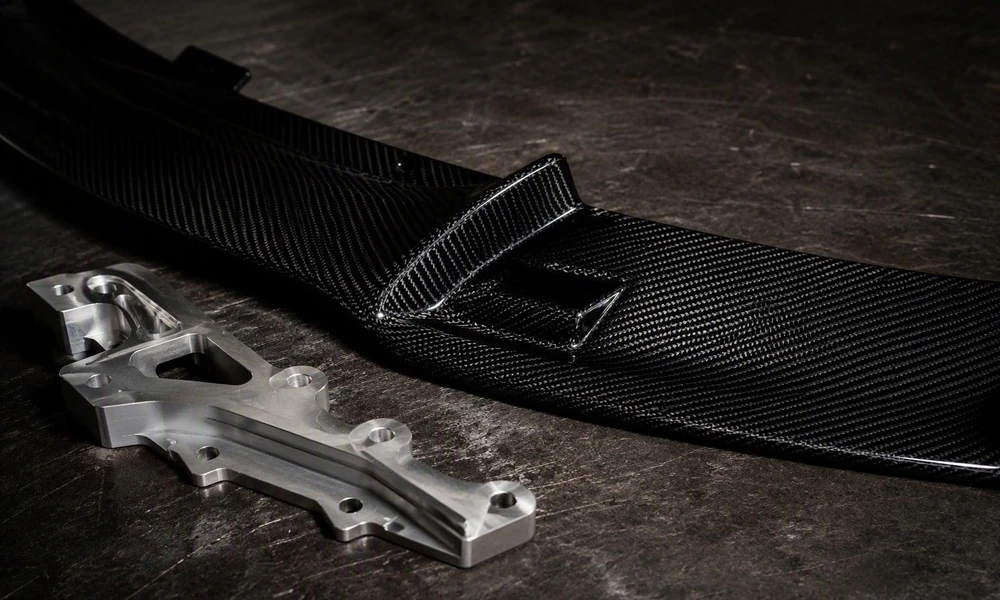

The material that built the twentieth century meets the one building this one.
For over a hundred years, to say ‘car’ was to say ‘steel.’ The frame, the body, the crash structure, the very idea of what an automobile is made of, steel wrote all of it. So when carbon fiber started appearing in serious road cars, it was not just a new material arriving. It was the first credible challenge to the longest-running dynasty in manufacturing. Understanding the challenge means understanding both materials honestly.
The Case for the Incumbent
Steel earned its century. It is strong, stiff, cheap, weldable, formable, repairable, and recyclable. And the world’s supply chains, factories, and body shops are all built around it. Modern high-strength steels deliver tensile strengths of 400 to 1,200 MPa, and steel’s modulus sits at a reliable 200 GPa in every direction at once. No drama, no surprises. When an engineer specifies steel, the material shows up exactly as ordered, behaves exactly as modeled, and can be fixed after a crash by any competent shop on any continent. That is not a legacy. That is a feature set.
The Case for the Challenger
Carbon fiber composite counters with one overwhelming number: density. Steel runs about 7.85 grams per cubic centimeter. Carbon composite runs 1.5 to 1.8. For equivalent volume, the composite is four to five times lighter. And its tensile strength, at 600 to 3,500 MPa depending on grade and layup, meets or exceeds most steels outright. The carbon steel vs carbon fiber comparison lays out the full property table, and the weight column is the one that ends arguments.
Why the Change Took So Long
If the numbers favor carbon so heavily, why did the transition take decades? Because numbers are not systems. Steel’s advantage was never just properties, it was infrastructure. A century of stamping presses, welding robots, paint lines, repair knowledge, and recycling loops made steel the default in a way no material property could dislodge. Carbon had to build its own ecosystem: fiber plants, prepreg suppliers, autoclaves, trained laminators, repair protocols. The material was ready in the 1980s. The system around it took thirty more years.
Where the Challange Landed First
Carbon did not attack steel’s fortress directly. It colonized the edges: supercar monocoques in the 1990s, then premium sports car roofs and panels, then performance options on ordinary cars. Each beachhead taught the industry how to design, build, and repair with the new material. The pattern is classic disruption. Start where the incumbent’s advantages matter least and the challenger’s matter most, then expand as the ecosystem matures.
What Each Generation Optimized
There is a fair way to frame the two eras. Steel optimized the car for manufacturing: stamped, welded, painted, assembled by the million. Carbon optimizes the car for physics: the lightest structure that does the job, shaped by aerodynamics rather than by what a press can stamp. Neither optimization is wrong. They answer different questions. One asks how cheaply a car can be built, the other asks how well a car can perform. The market, being the market, wants both answers at once, which is why the modern performance car is a steel-aluminum-carbon hybrid rather than a monument to any single material. And the composite side of that hybrid now spans everything from autoclave-cured supercar tubs to the seven-step carbon fiber fabrication process behind quality aftermarket panels.
The Real Succession
None of this requires disliking steel. The two materials are not rivals so much as relay partners. Steel carried the automobile through its first century of democratization, and carbon is carrying the performance frontier through the next. Respecting the handover is what keeps the comparison honest, and honesty is what makes the numbers worth quoting.
- Mass-market cars: steel’s economics remain untouchable, and will for years.
- Premium and performance cars: mixed-material construction, carbon where it pays.
- Supercars and race cars: carbon structure is now the price of entry.
- Aftermarket: carbon panels and aero bring the physics to cars steel still owns.
The Next Twenty Years
The trajectory is not hard to read. Fiber production keeps scaling, automated layup keeps improving, and compression-molded processes keep cutting cycle times. None of that makes carbon cheap. But each step pushes it down another tier of the market, exactly as it descended from F1 to supercars to the aftermarket. The car of 2045 will not be all-carbon any more than today’s is all-steel. It will be mixed-material, optimized zone by zone, with carbon holding every position where weight is money.
Steel’s response deserves respect too: advanced high-strength grades and hot-stamped geometries keep making steel structures lighter without changing the material’s fundamental virtues. The dynasty is not collapsing. It is specializing. Ceding the performance frontier, keeping the mass market, and remaining, as ever, the material every other material gets compared to.
Steel built the automobile, and it is not done. But the definition of a serious performance car is now written in carbon, and that definition is not changing back. The century of steel is giving way to the century of composites. Not with a revolution, but one panel, one chassis, one brake disc at a time.


